How UAD 3.6 Changes Operations for Appraisal Management Companies
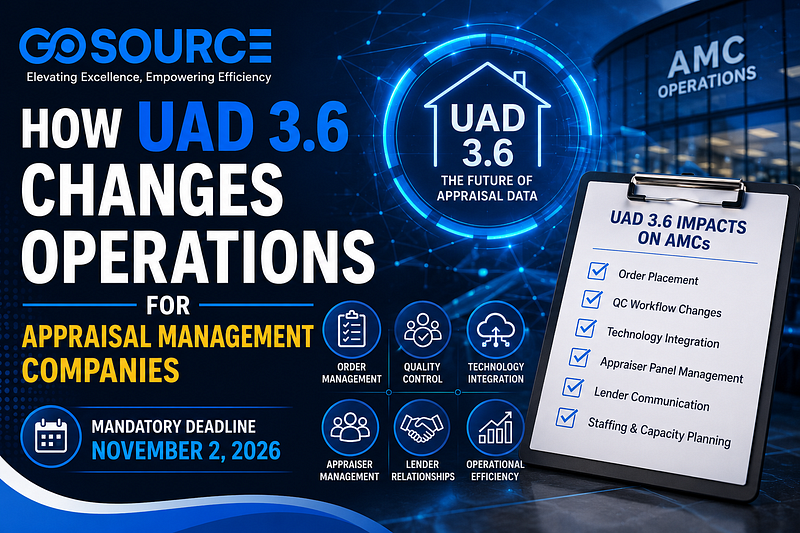
For months, most conversations around UAD 3.6 have focused on appraisers’ new forms, updated terminology, XML files, and software upgrades. But for Appraisal Management Companies, the impact runs much deeper. UAD 3.6 doesn’t just change how appraisal reports are delivered. It changes how AMC operations function from beginning to end. Order intake, quality control, lender communication, technology integrations, appraiser panel management, and compliance tracking affect every department in some way. And the closer we get to the mandatory transition date of November 2, 2026, the more important it becomes for AMC leadership teams to fully understand what this operational shift involves.
Because this is not simply a “technology update.”
It’s a workflow transformation.
First, What Is UAD 3.6?
Before diving into the AMC side of things, it helps to quickly clarify what’s changing.
UAD 3.6 replaces the traditional static appraisal forms, including the 1004, 1073, and 2055, with a single dynamic appraisal reporting structure built around machine-readable XML data.
Instead of filling out fixed PDF forms, appraisers now complete a dynamic Uniform Residential Appraisal Report (URAR) that adapts based on the assignment type, inspection scope, and property characteristics.
The result is:
- More structured appraisal data
- Standardized terminology
- Better automation for lenders and GSEs
- Improved validation and compliance tracking
- Faster system integration across the mortgage ecosystem
If you want a complete overview of the standard itself, start here:
https://gosourceval.com/what-is-uad-3-6/
You can also read our related guide here:
https://gosourceval.com/uad-3-6-compliance-checklist-appraisers/
Now let’s talk about what this means operationally for AMCs.
1. Order Placement Becomes More Detailed and More Important
Under the old process, AMCs could often place an appraisal order with minimal upfront information. The appraiser would gather additional details later while completing the report.
That approach doesn’t work well under UAD 3.6.
Because the new dynamic URAR structure is built around the information provided at the time the order is created, incomplete property details can immediately create workflow problems.
If the order lacks key property information, the appraiser may not be able to properly configure the report structure, which can lead to:
- Delays
- Revision requests
- Submission failures
- QC complications
- Turnaround time issues
In other words, the quality of the order intake process suddenly becomes much more important than it used to be.
What AMCs should focus on:
- Updating lender intake forms
- Expanding property data collection requirements
- Adding validation checks during order placement
- Training coordinators on UAD 3.6 field expectations
- Standardizing order workflows across teams
Many downstream issues can be prevented simply by improving the accuracy of the order setup process.
2. Quality Control Workflows Will Need Major Updates
This is one of the biggest operational changes for AMCs.
Most QC teams today are trained to review traditional appraisal forms. Under UAD 3.6, those workflows change significantly.
The new Submission Summary Report (SSR) introduces:
- Color-coded feedback
- Machine-readable review outputs
- Updated validation logic
- Expanded data review requirements
At the same time, appraisers will now be reporting much more detailed information, including:
- Room-level condition and quality ratings
- Expanded comparable property data
- Energy-efficient features
- Disaster mitigation features
- Standardized property characteristics
That means QC reviewers need to learn not only the new format , but also what compliant reporting actually looks like under the updated structure.
What AMCs should do now:
- Rewrite QC checklists for UAD 3.6
- Retrain reviewers on the new URAR structure
- Update revision request templates
- Integrate the new SSR format into internal systems
- Build testing workflows before the deadline
This retraining process often takes longer than expected because reviewers must evaluate every field for compliance, not just verify completion.
3. Technology Integration Is the Biggest Risk Area
This is where many AMCs underestimate the scope of the transition.
UAD 3.6 is not simply a new report format. It introduces an entirely different data structure built around XML and MISMO standards.
That affects nearly every system inside an AMC’s technology stack.
Systems that need evaluation include:
- AMC order management platforms
- Appraiser portals
- QC software
- Lender integrations
- Reporting dashboards
- Compliance tracking systems
- Data storage architecture
The important question is no longer:
“Can the system open the file?”
The real question is:
“Can the system properly process, validate, transfer, and display the structured data inside the file?”
That’s a much larger challenge.
What AMCs should prioritize:
- Get written UAD 3.6 readiness confirmation from vendors
- Run end-to-end testing during the Broad Production Period
- Identify high-risk vendor dependencies early
- Build contingency plans for delayed integrations
- Coordinate directly with lender technology teams
One of the most common transition failures happens when AMCs assume vendors are ready without verifying compatibility.
4. Appraiser Panel Management Becomes a Compliance Responsibility
Under UAD 3.6, AMCs are no longer simply managing appraiser relationships; they’re managing operational readiness across their panel.
If an appraiser submits a report from non-verified software, the report may fail UCDP submission, which creates problems for both the lender and the AMC.
That makes appraiser readiness a genuine compliance issue.
AMCs should begin:
- Surveying appraisers about software readiness
- Tracking verified vs. non-verified platforms
- Prioritizing prepared appraisers for assignments
- Setting internal readiness deadlines
- Communicating expectations clearly across the panel
The earlier this process starts, the easier the transition becomes.
Waiting until late 2026 to verify panel readiness creates unnecessary operational risk.
5. Lender Communication Matters More Than Ever
Your lender clients are also dealing with major internal changes right now.
They’re updating underwriting systems, LOS integrations, compliance processes, and review workflows all while trying to maintain loan production.
That means they’re looking to their AMC partners for confidence and clarity.
The AMCs that communicate proactively during this transition will strengthen lender relationships significantly.
The ones that stay silent and reactive may lose trust quickly if issues appear after the deadline.
Strong AMC communication includes:
- Sharing your UAD 3.6 readiness timeline
- Explaining changes to order placement requirements
- Helping lenders understand the new SSR format
- Providing designated UAD 3.6 support contacts
- Being transparent about implementation progress
Transitions like this create pressure, but they also create opportunities to stand out as a reliable operational partner.
6. Staffing Pressure During the Transition Is Real
Even well-prepared AMC teams will feel pressure during the months surrounding the November 2026 deadline.
Your operations staff will likely be handling:
- Mixed UAD 2.6 and UAD 3.6 workflows
- Increased lender questions
- More appraiser support requests
- Additional QC review complexity
- Live technology troubleshooting
This is where many high-volume AMCs struggle, not because they lack strategy, but because internal bandwidth becomes overloaded.
That’s why operational support matters.
At Go Source Valuation, we help AMCs manage high-volume appraisal operations through services like:
- Appraisal review support
- Quality control assistance
- Data entry services
- Workflow management support
- Back-office operational assistance
Learn more here:
During a transition as large as UAD 3.6, having experienced operational support can reduce pressure on internal teams and help maintain service quality during the adjustment period.
Final Thoughts
UAD 3.6 is not just an issue.
It’s a full operational shift for the entire mortgage valuation ecosystem and Appraisal Management Companies to sit directly in the middle of it.
The AMCs that prepare strategically now will likely come through this transition with:
- Better operational workflows
- Stronger lender relationships
- More scalable systems
- Better-trained teams
- Stronger appraiser panels
The mandatory deadline is set for November 2, 2026.
That still leaves time to prepare properly, but the preparation window is shrinking quickly.
The best time to start building your transition plan is now.
Frequently Asked Questions
Q: Does UAD 3.6 affect small AMCs, too?
Yes. Any AMC working with loans tied to Fannie Mae or Freddie Mac will be affected, regardless of company size.
Q: Can AMCs still process UAD 2.6 reports after November 2026?
Only for certain legacy pipeline scenarios. All new UCDP submissions moving forward must comply with UAD 3.6 after November 2, 2026.
Q: How can we verify whether our vendor is UAD 3.6 ready?
Request written confirmation directly from your technology provider that their platform has completed UAD 3.6 verification and supports UCDP submission requirements.
Q: What is the biggest mistake AMCs make during this transition?
Treating UAD 3.6 as only a software issue.
The transition affects technology, staffing, QC, lender communication, appraiser management, and operational workflows simultaneously. Focusing on only one area usually creates problems elsewhere.